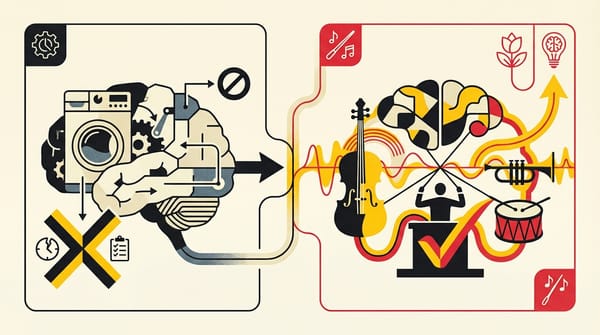
Guardé 200 artículos de IA el mes pasado. Leí cero. Así salí del ciclo.
Guardas artículos que nunca lees. Lees más y te sientes peor. El problema no es la IA—es la incertidumbre. Y hay una salida.

You open LinkedIn. There's a post about how AI replaced an entire marketing department. You scroll. Another one—programmers will be obsolete in two years. Then a listicle: "10 AI Tools You Need or You'll Fall Behind Forever." You save it but don't open it. Because yesterday you saved 15 just like it.
Sound familiar?
This is anxiety. But not the kind where something's actually chasing you. The kind where the threat feels real, but what it actually is, what you're supposed to do about it, how to respond—none of it is clear.
Here's what I've come to realize: the problem isn't AI, or the market, or the economy. The problem is uncertainty. When you don't understand what's happening, you start hoarding information. More articles. More podcasts. More opinions.
But information designed for media consumption doesn't help you decide anything. It's built for engagement, not action. So you get trapped in a loop: read—feel anxious—read more—feel worse.
It means: when anxiety hits, your job is to get to a concrete action as fast as possible. Not perfect. Not optimal. Just—concrete. If it turns out wrong, you'll course-correct. But first, do something instead of endlessly rotating options in your head.
And here's the part that's hard to swallow: certainty and decisiveness matter more than being right. Because "right"—nobody actually knows what that is in these situations. If they did, you wouldn't be anxious.
You can't wait for someone else to hand you clarity. You have to manufacture it yourself—through an act of will. Even if the decision turns out to be wrong.
I have a specific formula for this. Here it is.
Decide, do, pay, repeat
Four words that work in any situation where you're drowning in uncertainty. Five steps:
Step 1. Gather information—to make a decision.
Not to "stay informed." Not "just in case something changed." You sit down, read, listen—with one goal: to decide. The moment you have enough to choose—stop. More reading after that point is actively harmful.
Step 2. Pick one and discard the rest.
Not "keep in mind." Not "we'll see how it goes." Discard. You picked option A—options B, C, and D no longer exist. They're dead to you.
Step 3. Accept the price.
Every decision costs something. It might be wrong. It might hurt. You need to say this out loud to yourself: "I'm willing to pay for the consequences of this decision. Here's the specific price, and I accept it."
Step 4. Define triggers for reconsideration.
Not internal feelings like "I'm anxious again." Concrete external factors: "If X happens—I reconsider. If X hasn't happened—I stay the course, no second-guessing."
Step 5. Act.
That's it. Decision made. Now—execute. Don't look back, don't doubt, don't revisit until the trigger from step 4 fires.
Sounds straightforward. But every step is an act of will, because an anxious brain wants the exact opposite: gather information forever, keep all doors open, avoid paying any price, and reconsider daily.
Let me show you how this actually plays out.
Example 1: Choosing an AI tool
Early 2025. LinkedIn feed—pure chaos. Every day brings a new AI announcement. Every week—"the tool that will change everything." GPT-5, Claude, Gemini, Llama, Mistral, Copilot, Cursor, Devin, plus a dozen names you'll forget by next month.
Everyone's testing. Comparing. Writing reviews. Sharing prompts. A race with no finish line.
Nothing computes. Which tool? What to learn? What to bet on? What if tomorrow something better drops and everything you learned becomes worthless?
I ran the formula:
- Researched the main contenders—not all of them, just the major players. Goal: make a decision, not build a bookmark graveyard
- Picked Claude Code as my primary tool. Discarded the rest. Not "parked for later." Discarded
- Accepted the price: maybe another tool fits better. Maybe I'll miss something important. That's the cost I'm willing to absorb
- Trigger for reconsideration: if Claude Code stops handling my actual work. Not "if someone on Twitter raves about X"—specifically, if my tool can't do what I need
Done. Now—I work. I learn. I build.
Is this the right choice? Maybe not. Maybe Cursor would serve me better. Maybe six months from now something fundamentally new appears. Maybe.
But I have a plan. And I'm executing it. I'm not burning time endlessly comparing tools I don't actually use.
While people around me "test a new AI" every week and haven't shipped anything with any of them—I've built a workflow that produces real output. Am I afraid I'll miss something? Sometimes. Anxious? No. Because I have a concrete decision and a concrete trigger for when to revisit it.
The goal was never to find the perfect tool. The goal was—to stop doomscrolling and start shipping. Decision locked, now—I move.
Example 2: Career after emigration
The same formula applies to career moves. Or more precisely—I know what happens when you don't use it.
Several years back, I emigrated. New country, new language, zero network. No clue how to earn money. No clue what skills the market wanted. No clue about anything, really.
And instead of picking one direction and killing the rest—I tried learning everything simultaneously. Motion design. Python. Data analytics. Something else. And more.
Every week—a new course. Every month—a new "promising field." Zero discarded options. Zero decisions made. Zero triggers defined. An endless sprint where you're running in every direction at once.
I pushed until my body quit. Not Instagram-burnout where you need a wellness retreat. The kind where attempting to think makes you nauseous. Where you black out. Where your body physically refuses to continue.
Recovery took five months working at a bar. No career thoughts. No learning attempts. No plans. Just hands, glasses, people.
That's when it clicked: the problem wasn't the workload. The problem was the absence of a decision. I kept every option alive, refused to pay the price on any of them, never defined when to stop. My brain couldn't handle the open-ended uncertainty—and it shut itself down.
Now I operate differently. Picked a direction. Killed the rest. Accepted the price: maybe it's not the optimal path. Trigger: if I see no growth in a year—I reassess. Not sooner.
Is this the right path? Maybe not. But I can live with it.
Example 3: Blogs and platforms
The same cycle tried to start with my blogs.
I moved to Spain. Didn't know if I'd stay. Didn't know who to write for. Russian? English? Spanish? Which platform? WordPress? Medium? Social? Which audience—Russian speakers, international, local Spanish?
All variables open. Not a single decision. An infinite loop forming.
Then I remembered how infinite loops end. Five months behind a bar taught me well.
So I just decided:
- I'll keep doing what I love—writing about content and communication. Not because market research said it's lucrative. Because it's mine
- Personal blog—two languages: English, Spanish. I live in Spain, I write for the world and for the country I'm in
- Professional blog—English only. No Spanish version. Why—I'm not saying
- Ghost. Not WordPress. Not Medium. Not a social platform. Ghost—because I own it. No algorithm can throttle it, no platform can yank my audience. It's simple, powerful, and beautiful. I love tools that do a lot with little
No market analysis. No competitor deep-dives. No A/B-testing platforms.
Could WordPress give me better SEO? Possibly. Could a Spanish version of the professional blog attract more readers? Maybe. Could social media accelerate growth? Probably.
But those are the five percent I'm not chasing. I priced out the cost of being wrong. Built it into my internal budget. And got to work.
While others debate which platform to use, which language to write in, which audience to target—I have three blogs, three languages, and a publishing system that runs daily.
The bottom line
Don't drown in a thousand sources. Don't keep options breathing. Don't wait for the perfect moment.
Make a decision. Name the price to yourself. Define when to reconsider. And act.
Where there's action, there's no anxiety.