No estás roto: el duelo amoroso es un trabajo sin horario ni días libres
El duelo amoroso no viene con manual, pero sí con una certeza: lo que sientes es normal, millones lo viven ahora mismo, y aunque no lo creas, esto pasará.


Why breakup books don't work — while you're still grieving
Here's a funny thing I discovered by accident, wandering through bookstore shelves in a state far from academic curiosity. There are way fewer books about breakups than about building relationships. Humanity, apparently, decided that construction is more interesting than sifting through rubble. Optimistic, isn't it?
But here's the thing about timing. When you're in the thick of grief, any advice is irritating — kind of like being told to "calm down" when you're already losing it. It's like handing a knight who just got thrown off by a dragon a manual on horseback riding. But in calmer moments, you realize: wait, there were actually some good points in there.
Can you let go of love by following instructions? Dovlatov once noted: "We endlessly curse Comrade Stalin, and rightly so. Yet I want to ask — who wrote four million denunciations?" Meaning — the problem is always a bit more complicated than it seems. Same with breakups: a book won't give you a recipe. But it will remind you that your feelings are normal. That millions of people are going through the exact same thing right now. And that, strangely enough, this will pass.
Three paths after a breakup
So when everything falls apart, we have three options — like in an old fairy tale, just without the horse and the signpost at the crossroads:
- Mourn the past — a well-worn path and, let's be honest, the most popular one.
- Dismiss it and move on — "whatever, it was nothing anyway" — you tell yourself, staring at the ceiling at 3 AM.
- Work through the grief and learn something — the most thankless route. But the only one that actually leads somewhere.
Most of us cry first. Then dismiss. And if we're lucky — like heroes who accidentally stumble into the right cave — we make it to the third.
What the books suggest
Three steps: self-care, processing grief, being proactive.
Being proactive doesn't mean "delete the rest of your life from the schedule." If you go dancing after a breakup — that's not betraying your suffering. It's a step toward living. Dovlatov wrote: "Life diverged from literature, as usual" — and that's normal. Give yourself permission to feel joy, to see friends, to laugh unexpectedly on a random Tuesday.
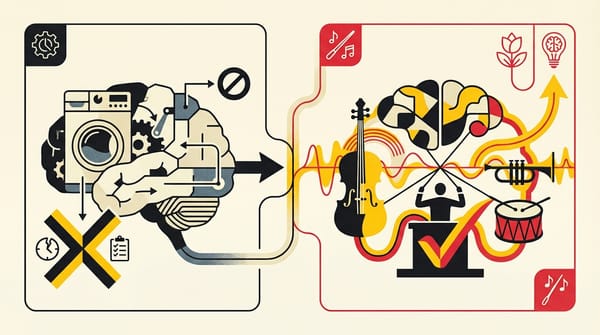
And grief — it's like a job. Hard, thankless, no bonuses or office parties. You have to accept that it's going to suck. And only then, step by step, can you walk out of that dark corridor.
Grief is physical
A lump in your throat. Cold in your stomach. These aren't metaphors — your body processes what happened more honestly than your head does.
There's no right way to express grief. Crying is normal. Anger is normal. Hatred, too. Seeking solitude, turning off your phone, eating ice cream straight from the tub — all included in the standard package. As Dovlatov said: "A person gets used to everything. To the bad and even to the good" — you get used to grief too, and then, without noticing, you start climbing out of it.
When "doing your best" means brushing your teeth
Even in the middle of grief, it matters to live each day. Sometimes "doing your best" just means brushing your teeth. Sounds pathetic? Not at all. Any wandering knight will confirm: in the most hopeless quests, the greatest feat is getting up in the morning and putting on pants.
Or throwing out your ex's stuff. Or — the audacity! — going on a date. The point is to take steps for yourself. Small, crooked, sometimes in the wrong direction — but yours.
The "But at least" exercise
A simple thing that helps you spot the good among the wreckage:
"Yeah, things are bad. But at least it's summer. At least there's someone I can call. At least my coffee's still warm."
These small doses of positive work like a potion — not a magic one, more like warm tea with honey in the middle of endless rain. They help you get through a day. Then a week. And eventually — all of it.
Moving forward isn't forgetting
"We do not choose our times. We can only decide how to live in the times that have chosen us" — that's not Dovlatov, that's Tolkien, but the point stands. Saving yourself, choosing yourself — that's what moving forward means.
Moving forward isn't forgetting the past. It's protecting yourself from getting stuck in it. It's not walking away from someone. It's walking toward yourself.
Three books that helped me
Susan Elliott "Getting Past Your Breakup" — about living through a breakup. No rose-colored glasses, no "just let it go." An honest book for honest grief.
Helen Fisher "Why We Love" — explains what happens in your brain and body when love leaves. Spoiler: chemistry, lots of chemistry. You're not going crazy — you're just going through withdrawal.
Julia Samuel "Grief Works" — useful for any adult. About how to support someone in grief without saying something monumentally wrong. As Dovlatov might have put it — "Compassion requires talent." This book helps you develop it.